PART 2 — THE SECRET BEHIND THE BADGE
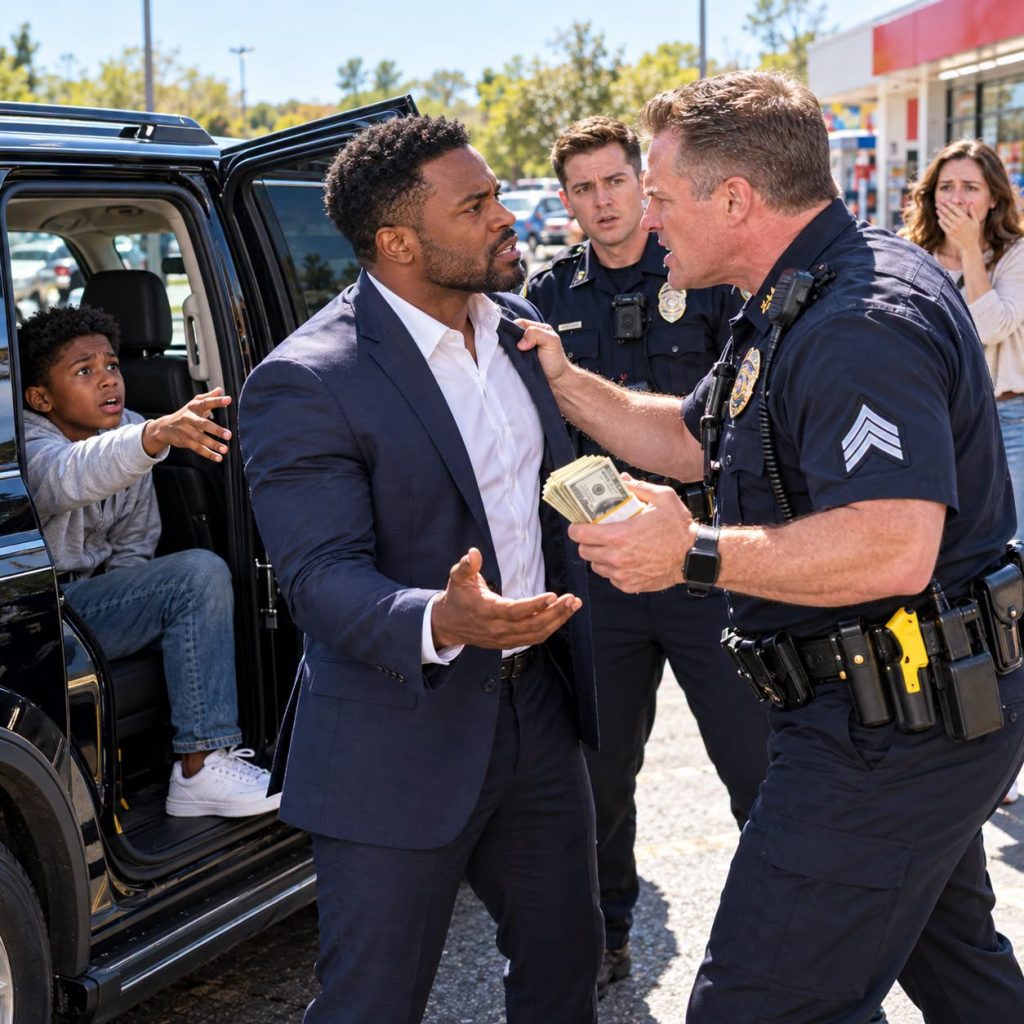
“Trevor, call our friend upstairs.” Briggs kept his hand near his holster while Sykes backed toward the patrol car. I stood directly between Marcus and the two officers. “Nobody needs to get hurt,” I said. Briggs laughed. “That’s entirely up to you.” Sykes lifted his radio, then hesitated. “Sergeant, this isn’t what we agreed to.” Briggs spun toward him. “You agreed to follow orders!” That moment told me something important: Sykes wasn’t comfortable with what was happening, but he’d participated long enough to know the routine.
Briggs suddenly lunged for my dashboard-mounted phone. I caught his wrist before he reached Marcus. He drove his shoulder into me, knocking both of us against the SUV. Marcus screamed. I redirected Briggs’s arm, broke his grip, and stepped back without striking him. “You just assaulted a police officer!” he shouted. “My dashcam will show exactly what happened,” I answered. Sykes grabbed Briggs’s sleeve. “Nolan, stop! There’s a kid here!” Briggs shoved him away. Then a voice crackled through the radio. “Unit Twelve, this is Voss. Status?” Briggs snatched the microphone. “We’ve got a problem. One of our usual arrangements. There’s a recording.” A pause followed. “Secure it,” Voss replied. “I don’t want another complaint on my desk.”
Another complaint. Those two words confirmed this wasn’t an isolated incident. Briggs approached again, but I lifted my hands and spoke calmly. “My son needs to get home. You have the money. Let us leave.” He studied me suspiciously. Finally, he returned my vehicle documents. “Drive away. Forget tonight.” I buckled Marcus into his seat, started the engine, and pulled onto the road. Only after we’d reached a well-lit gas station did my son begin sobbing. “Dad, why didn’t you tell them who you are?” I held him tightly. “Because knowing their boss was watching would’ve changed their behavior. We needed to know what they do when nobody important is looking.”
At 6:15 the next morning, I entered the County Office of Professional Integrity and handed Director Dana Mercer two encrypted copies of the recordings. Dana had worked alongside me on an earlier interstate investigation, and I trusted her judgment. She listened without interruption. When Voss’s voice emerged from the audio, her expression hardened. “Desmond, this may be bigger than Briggs.” “Then investigate all of it,” I said. “And keep my appointment out of the evidence review. I’m a complainant, not the case investigator.”
By that afternoon, Dana had located eight complaints filed over thirteen months. Every victim was either a newcomer, a late-shift employee, or someone unlikely to challenge the police. Cash had disappeared during roadside stops. Camera footage was consistently missing. Each complaint had been dismissed for insufficient evidence. Seven of those dismissals carried Raymond Voss’s electronic approval. The eighth bore the signature of someone I recognized from my incoming command staff.
Captain Evelyn Price.
The officer selected to lead my department’s new Internal Affairs Division.
Dana placed another document on the table. “There’s more. Price didn’t merely dismiss complaints. She reassigned every officer who questioned Briggs.” “And Sykes?” I asked. “His name appears on five stops.”
My phone vibrated. A message from an unknown number appeared.
Your son looks just like his mother. Keep your mouth shut if you want him safe.
Attached was a photograph of Marcus leaving the school registration office less than twenty minutes earlier.
I was already reaching for my keys when Dana’s emergency line rang. She answered, listened, and turned white.
“Desmond,” she whispered, “Marcus’s school just reported that someone wearing a Harbor Point police uniform attempted to sign him out.”
Then another message appeared on my phone.
You have until Monday’s ceremony to destroy the recording.
And beneath it was a photograph of my future police headquarters—taken from inside the chief’s private office.
PART 3 — THE CHIEF THEY NEVER SAW COMING
“Lock down the school. Now!” I shouted. Dana was already contacting county investigators while I raced toward Marcus’s building. His principal met me at the entrance. “Your son is safe. We refused the officer’s request.” Marcus ran into my arms. “Dad, he said you sent him!” I knelt, holding his shoulders. “I would never send someone without telling you first.” A school security photograph identified the visitor as Officer Trevor Sykes. But the next detail changed everything: Sykes had handed the principal a sealed note before leaving. Inside were six words. Check the command office evidence locker.
Dana immediately requested a preservation order for the locker records and surveillance footage. Investigators recovered duplicate traffic-stop reports, cash collection notes, and a memory card containing audio from several encounters. Sykes surrendered voluntarily that evening. “Briggs told me to get the kid,” he admitted during a recorded interview. “I couldn’t do it. I left the note instead.” Dana leaned forward. “Who ordered the complaints erased?” Sykes swallowed. “Voss approved the dismissals. Price managed the files. Briggs collected the money.” “And the threatening messages?” I asked. He looked directly at me. “Briggs sent them. He was watching your son.”





