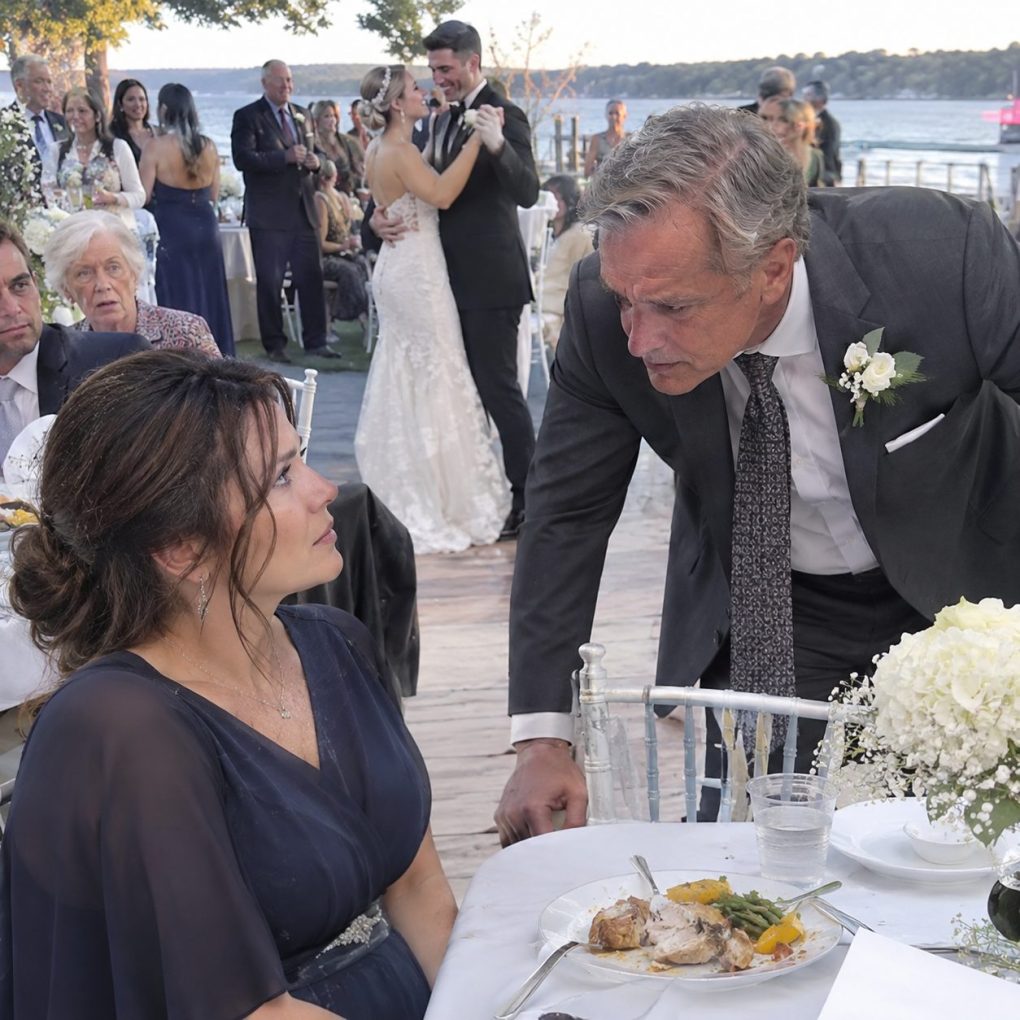
Claire’s hand slipped from Nathan’s sleeve.
“Dad paid the first venue deposit,” Nathan muttered, as if saying it smaller could make it disappear. “I was going to pay him back.”
Thomas stared at him. “You told us the deposit came from your own savings.”
Nathan said nothing. Claire looked at the photograph again, then at the empty chair marked for the groom’s father on the coordinator’s original plan.
“Is there anything else you’ve lied about?” she asked.
The coordinator reached into her folder.
“There’s an email from Nathan explaining why he wanted his father’s name removed from the family table,” she said. “I think you should read it.”
The coordinator opened Nathan’s email on her phone.
Nathan took the phone first. His eyes moved across the screen, and the color drained from his face. Claire held out her hand.
The email was dated the night before the wedding.
Please put Walter Bennett with the vendors. Claire’s family believes my father was absent. I don’t want questions or photographs that contradict that story.
Seeing my son write that he wanted me hidden hurt worse than the seating chart.
Claire read it twice. “You told me your father left you when you were eleven.”
Nathan whispered, “I was trying to sound like someone you’d respect.”
“You didn’t have to hide him from me,” Claire said. “I would have wanted to know him.”
Her voice was so steady that Nathan finally looked at her.
Thomas took off his glasses. “Son, I grew up above my father’s tire shop. You didn’t need to invent a harder childhood to belong here.”
Nathan’s shoulders collapsed. He admitted he’d been embarrassed by our rented duplex, my rusty truck, and the maintenance job he’d never respected. Each lie had made the next one easier.
I thought of Annie, who’d held Nathan when he was born and told me that whatever happened, he should never feel alone.
“I gave you what I could,” I told him. “I didn’t know you were telling people it was nothing.”
“I know, Dad.”
“No,” I said softly. “I don’t think you did.”
Claire asked the coordinator to put my chair back at the family table. I thanked her, but told her I needed some air. Outside, the water was darkening beneath the dock lights, and I could still hear guests talking through the open doors.
Nathan followed me with my photograph in his hand.
“I meant to fix things after the wedding,” he said.
“You don’t fix a lie by waiting until everyone stops looking.”
He rubbed the worn corner of the picture with his thumb. “I’m sorry.”
I believed he meant it in that moment. I also knew an apology couldn’t erase what he’d done to make the evening easier for himself.
I returned for the toasts. Thomas spoke briefly about marriage requiring honesty when it was uncomfortable. He didn’t name Nathan’s lie. Claire came over afterward, pulled out a chair beside hers, and asked if I would stay for cake.
I did, but I left before the last dance.
Over the following months, Nathan and Claire began counseling. She insisted he correct the story with her family; he did, personally, without asking me to make it sound better. He paid back the venue deposit in installments after I told him I would no longer cover unexpected bills.
Our first few conversations were awkward. Sometimes we sat in silence over coffee while he tried to find words that weren’t excuses. I didn’t rush him.
One Sunday he brought over the crooked bicycle photograph, newly framed. On its back he’d written: You were there for every mile.
I hung it by the kitchen door, near Annie’s picture.
I’d taken the staff-table place card with me. That night I folded it and put it away. It was a reminder of what I would never accept again—not from strangers, and not from my own son.
I had spent years making room for Nathan in my life. If he wanted me in his, he’d have to stop hiding the chair.
THE END.





