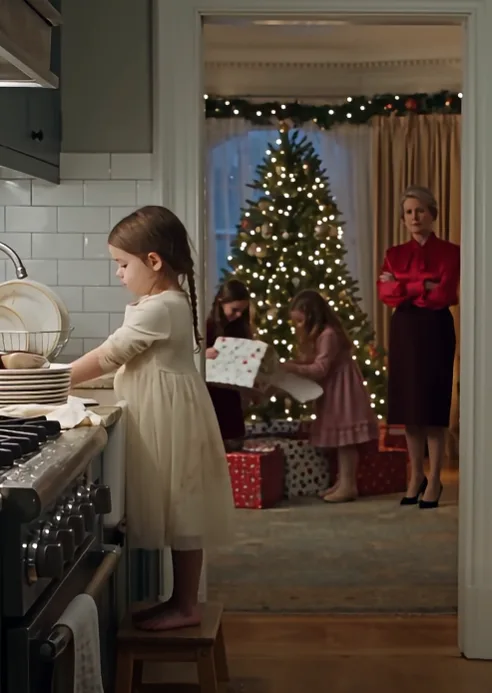
On Christmas Day, my mother made my six-year-old adopted daughter clean the family’s dishes while her cousins enjoyed expensive gifts. My father insisted Renata should understand she wasn’t considered their “real” granddaughter. When I reached for a sealed legal envelope, my mother cried, “Mauricio, please don’t open it!” Then Renata whispered, “Grandma already read that letter.”
“Keep washing, sweetheart. Those plates won’t get clean on their own.”
I paused just beyond the kitchen entrance.
My mother, Carmen, stood near the sink, watching my six-year-old daughter carefully work through a towering pile of used dishes.
“I’m doing my best, Grandma,” Renata murmured.
“Then put more effort into it. You’re supposed to help.”
Renata balanced on a wooden stool, her sleeves damp and her little hands pink from the warm water.
Across the hallway, her cousins, Sofia and Emma, laughed beneath the decorated Christmas tree, unwrapping expensive gifts as cheerful holiday music filled the house.
My daughter was cleaning the dishes everyone had abandoned.
“Renata.”
She turned around so suddenly that water scattered across the countertop.
“Daddy!”
The unmistakable relief in her voice affected me more deeply than anything my relatives could have said.
I faced my mother.
“Carmen, would you mind explaining what’s happening here?”
She kept wiping a crystal glass, behaving as though I’d disturbed her during a perfectly normal family gathering.
“What do you think, Mauricio? She’s helping with the cleanup.”
“She’s only six. Why is she cleaning everyone’s plates while Sofia and Emma are enjoying their Christmas presents?”
My mother eventually met my eyes.
“Because everyone needs to contribute in this household.”
For several seconds, I struggled to believe those words had actually left her mouth.
“She’s my little girl.”
“That doesn’t mean she needs special treatment.”
I watched her closely, hoping she’d recognize how unfair her explanation sounded. Instead, she set the glass aside and casually picked up another.
“Children should understand responsibility from an early age.”
Before I could respond, my father entered the kitchen.
“Mauricio, please don’t start an argument. It’s Christmas.”
I faced him immediately.
“Then tell me why your other granddaughters are opening gifts while my daughter is standing here cleaning up after everyone.”
His face grew stern. He glanced toward Renata, who had dropped her gaze and was holding tightly to the sink.
Then he spoke the words that changed everything.
“Paola’s daughters are our biological granddaughters.”
I remained silent, desperately hoping I’d misunderstood his meaning.
But he continued speaking.
“Renata should understand that things are different.”
Nobody spoke inside the kitchen.
Another wave of laughter drifted from the living room, accompanied by the rustling of torn wrapping paper. The difference was heartbreaking: two young girls enjoying Christmas while my daughter stood beside the sink, wondering why the relatives she loved made her feel like an outsider.
I had adopted Renata when she was just two. I’d comforted her through restless nights, celebrated her earliest milestones, and treasured the first moment she called me Daddy.
To me, she had always been my daughter.
Unfortunately, my relatives had long placed enormous importance on ancestry, family inheritance, and the separation between people they regarded as biological relatives and those who joined through adoption.
For years, I’d dismissed their remarks as outdated attitudes that would eventually disappear. I kept convincing myself that time would help them embrace Renata without reservation.
But standing there that afternoon, I finally recognized how mistaken I’d been.
Renata stepped off the stool and rushed into my arms. She wrapped her little arms around my leg and buried her face against my trousers.
“Daddy, have I done something wrong?”
My frustration softened immediately.
I crouched beside her and gathered her gently into my arms.
“No, sweetheart. Please look at me.”
She lifted her watery eyes to meet mine.
“You haven’t done anything wrong at all. Do you understand?”
She nodded quietly, although the worry remained visible on her face.
“Then why does Grandma seem upset with me?”
I hugged her more tightly.
“You haven’t caused any of this.”
Behind us, my mother released a frustrated sigh.
“Mauricio, you’re turning something small into a much bigger problem.”
I faced her again, keeping Renata safely in my arms.
“No. You made a little girl think she needed to prove she belonged here by doing everyone else’s chores.”
My father moved closer.
“Be careful how you speak.”
“And if I don’t?”
His expression tightened, yet he offered no response.
I carried Renata away from the kitchen, passing the glittering Christmas tree and colorful presents without interrupting Sofia or Emma. My daughter leaned against my shoulder, her tiny fingers holding firmly to the fabric of my shirt.
Suddenly, I remembered her drawing.





