The first person to call her an easy spar was twenty-six years old and had never been hit by anyone who knew how to wait.
His name was Blake Harmon.
Black belt.
Regional tournament medalist.
Six feet tall.
Fast hands.
Good kicks.
Excellent confidence.
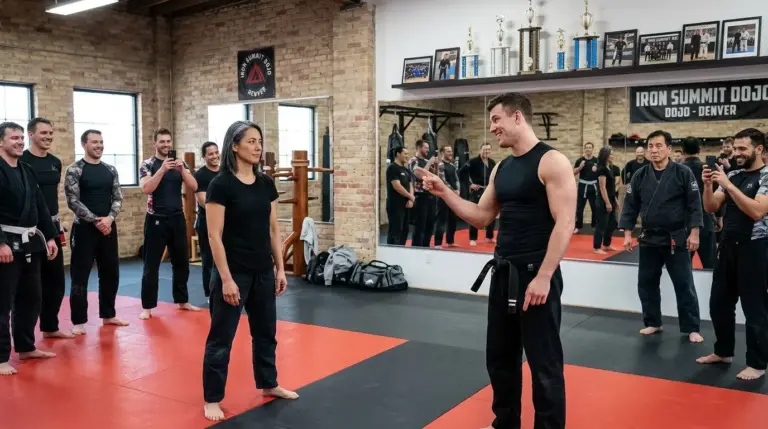
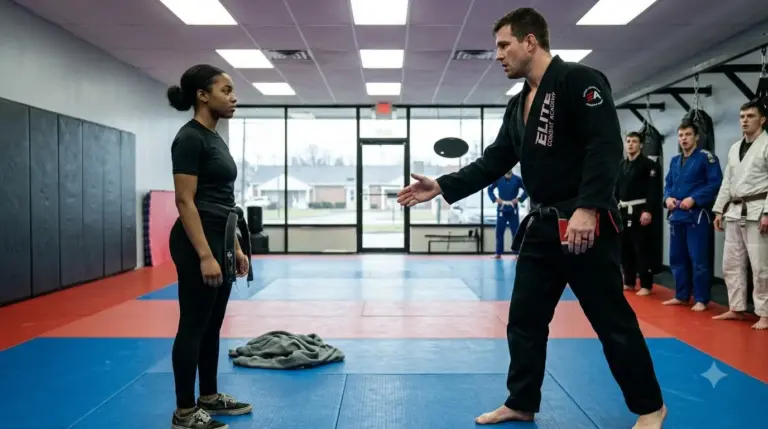
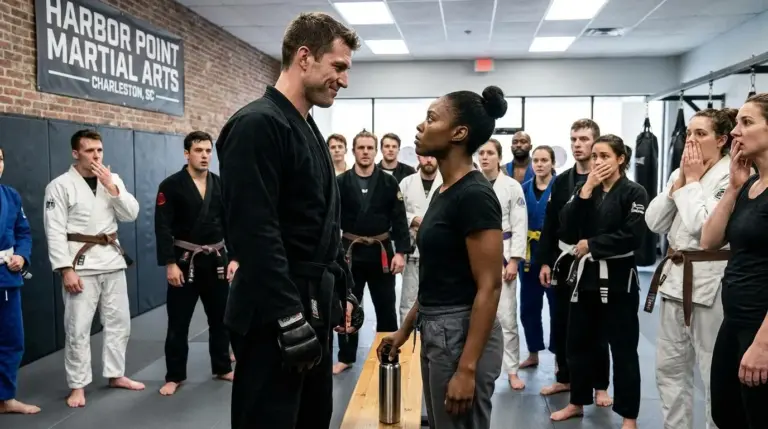
He looked across the training floor at the quiet woman standing beside the water cooler and smiled.
“That’s mine.”
His teammate laughed.
“What?”
“For the rotation.”
Blake nodded toward her.
“Easy spar.”
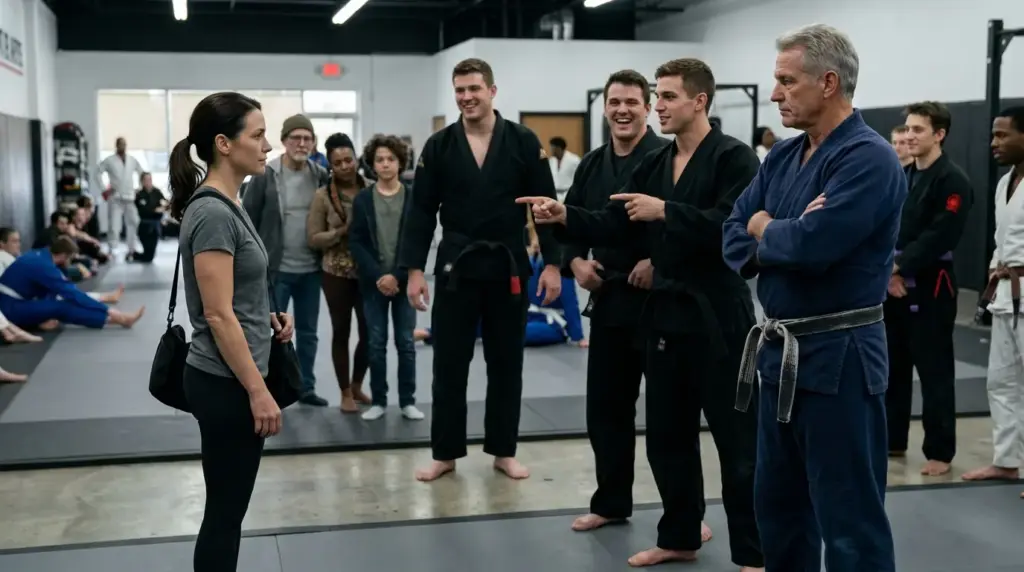
The second black belt, Mason Doyle, looked over.
The woman was maybe forty.
Five foot four.
Plain black leggings.
Gray training shirt.
No school patch.
No visible rank.
Hair tied low.
She stood with one hand around a paper cup and the other resting against the strap of a small gym bag.
She did not look nervous.
She also did not look eager.
Mason grinned.
“Save some for the rest of us.”
A third black belt, Trevor Lane, heard them.
He glanced over.
“New student?”
Blake shrugged.
“Guest.”
“Beginner?”
“Looks like it.”
Then a voice behind them said,
“Don’t underestimate her.”
All three turned.
Coach Daniel Mercer stood with his arms folded.
Fifty-eight.
Silver hair.
Black belt old enough to have faded almost white along the edges.
He was not smiling.
Blake laughed.
“Coach, come on.”
Daniel looked at him.
“I said don’t underestimate her.”
Mason glanced back toward the woman.
“She’s what, a mom?”
Daniel’s expression changed.
Not anger.
Disappointment.
“Interesting question.”
Mason frowned.
“What?”
“You looked at her for three seconds and decided you knew what she was.”
Trevor said,
“We’re just joking.”
Daniel nodded.
“Most bad habits start there.”
Blake smiled.
“You know her?”
Daniel looked across the room.
The woman met his eyes.
He gave the smallest nod.
She gave one back.
“Yes,” he said.
Blake’s smile faded a little.
“How?”
Daniel turned away.
“You’ll find out if she wants you to.”
That should have ended the conversation.
It did not.
Because young black belts are often most curious about things they are warned not to touch.
The gym was called Harbor Point Martial Arts.
It sat above an old furniture warehouse near the river in Louisville, Kentucky.
The building was ugly.
The school was not.
Daniel Mercer had spent twenty-three years building the kind of place where competitors trained hard without making beginners feel stupid.
At least that was what he tried to build.
Most days, it worked.
Kids’ classes ran at four.
Adults at six.
Competition team at seven-thirty.
Saturday mornings belonged to open training.
No formal curriculum.
Just drills.
Rounds.
Questions.
Coffee.
A few older members sitting near the edge pretending they were there to stretch.
The woman Blake called an easy spar had been invited by Daniel.
Her name was Leah Bennett.
She was forty-one years old.
She worked as a respiratory therapist at St. Vincent Medical Center.
Night shifts mostly.
Twelve hours.
Sometimes more.
She had a seventeen-year-old son named Caleb who thought everything she did was slightly embarrassing.
She owned a small brick house.
Drove an eight-year-old Subaru.
Hated olives.
Loved old blues records.
And had not trained inside a public martial arts school in almost ten years.
That last detail mattered.
Leah had not come to Harbor Point looking for a fight.
She came because Daniel asked her to.
Three weeks earlier, he called while she was leaving the hospital after a night shift.
“Need a favor.”
“No.”
“You don’t know what it is.”
“Still no.”
Daniel laughed.
“Same.”
Leah opened her car.
“What?”
“I’m running a women’s fundamentals clinic Saturday.”
“Good.”
“I need another experienced body.”
“No.”
“You can hold pads.”
“No.”
“Demonstrate movement.”
“No.”
“Drink coffee aggressively.”
Leah paused.
“That I can do.”
Daniel smiled through the phone.
“Come.”
She sighed.
“Why?”
“Because half the women coming are over thirty-five and they keep seeing twenty-two-year-old athletes demonstrate everything.”
“That sounds like a programming problem.”
“It is.”
“So fix it.”
“I’m trying.”
Leah leaned against the car.
Daniel continued.
“I need someone who understands what it feels like to train after life gets in the way.”
That landed.
Leah looked across the hospital parking lot.
Dawn was breaking behind the buildings.
Pink sky.
Cold concrete.
Ambulance lights reflecting in the glass.
“You have other people.”
“Yes.”
“Then use them.”
“I want you.”
“Why?”
Silence.
Then Daniel said,
“Because you never needed the room to know you were good.”
Leah closed her eyes.
“That sounds like manipulation.”
“It is.”
“Bad manipulation.”
“Still working.”
She laughed despite herself.
“Saturday?”
“Ten.”
“I’ll hold pads.”
“Good.”
“No sparring.”
“Fine.”
“Daniel.”
“I said fine.”
He was lying.
Not intentionally.
But he knew open training followed the clinic.
He also knew curiosity.
The clinic went well.
Leah arrived in a hoodie.
Helped with movement drills.
Held pads.
Explained breathing.
Nothing dramatic.
The participants liked her because she did not talk like an instructor.
She talked like someone who had been tired before.
When a woman named Rosa apologized for needing breaks, Leah said,
“You don’t owe anybody exhaustion.”
When another participant said she felt too slow, Leah asked,
“Slow compared to what?”
The woman shrugged.
Leah smiled.
“Then don’t invent a race.”
Daniel watched from the side.
That was why he invited her.
Not technique.
Perspective.
Leah understood bodies after forty because she lived in one.
She understood fear because she worked in an ICU.
She understood the strange shame adults bring into new physical spaces.
The clinic ended at noon.
Most participants left.
Some stayed to watch open training.
Leah should have left too.
She almost did.
Then Daniel asked her to help stack pads.
She agreed.
That took ten minutes.
Then Caleb texted.
Practice running late. Don’t pick me up until 2.
Leah stared at the message.
Extra hour.
Bad timing.
Daniel saw.
“You staying?”
“For coffee.”
“Good.”
“No rounds.”
“Understood.”
That was when Blake noticed her.
The competition team had arrived.
Young.
Fast.
Loud.
Mostly respectful.
Mostly.
Daniel believed arrogance should be corrected early.
But confidence at that age often grew faster than self-awareness.