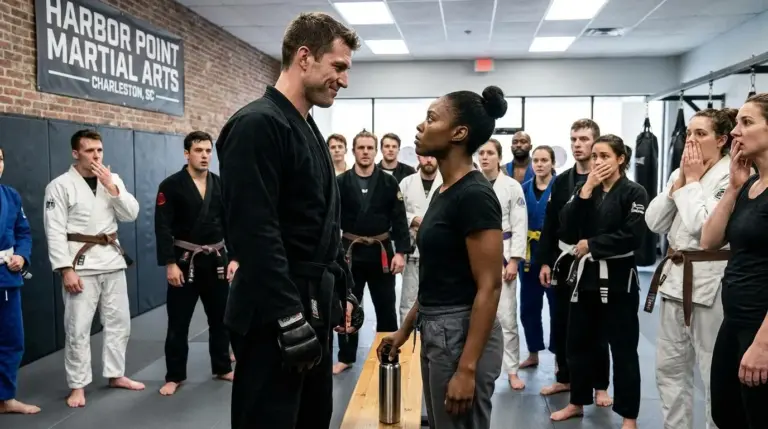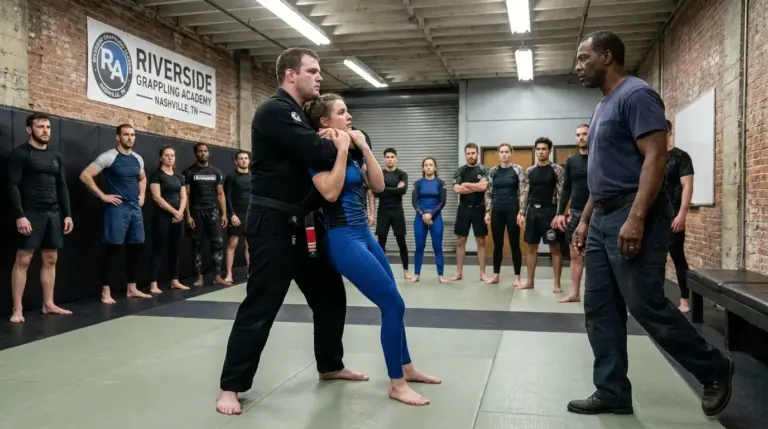
“Hold her arms,” Grant Mercer said. “If she wants to train with champions, she can learn what losing feels like.”
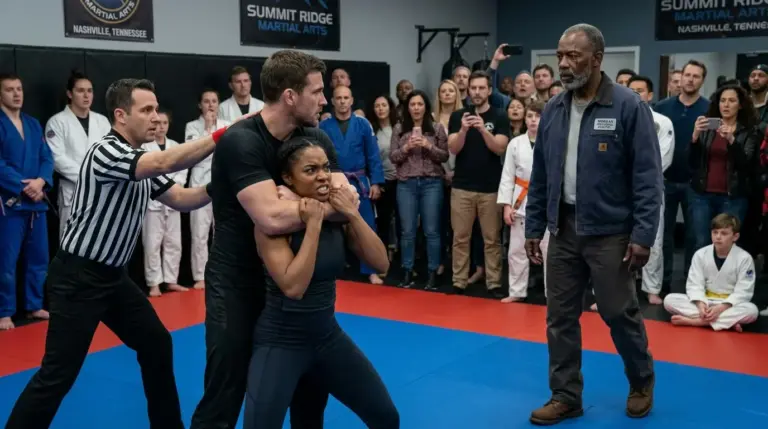
The three young men had surrounded Lena Carter in the middle of Bellweather Martial Arts Academy, where forty people had been watching a Saturday demonstration. Grant caught the front of her white uniform. His friend Derek Shaw seized one sleeve, and Travis Pike took the other. Lena felt the fabric pull tight across her shoulders. She knew exactly how old the stitching was. She had put the final repair into that jacket at two in the morning while her mother slept in a hospital bed ten years earlier.
“Let go,” she said.
Grant grinned for the phones raised around the mat. “Then make us.”
There was a sharp ripping sound. The seam gave first. Then the back panel split nearly to the collar, exposing the gray cotton shirt Lena wore beneath it. A few people laughed because Grant was laughing. Someone near the mirrors said, “Come on, man,” but nobody moved.
Lena didn’t throw a punch. She carefully folded her arms across her chest, as if holding the ruined jacket together might also keep something inside her from breaking. Across the mat, the academy’s elderly founder rose so suddenly from his chair that his cane clattered against the hardwood.
“Where did you get that uniform?” Samuel Bell asked.
Grant opened his mouth, ready with another joke. Samuel wasn’t looking at him. He was staring at the dark blue hand-stitched initials inside Lena’s collar, initials that had become visible when the cloth tore.
Lena looked down at the floor. “It belonged to my mother.”
Samuel’s face went gray. “What was her name?”
“Marian Carter.”
The laughter stopped. No one shifted. Even the children lined up along the far wall seemed to understand that something much larger than a torn jacket had entered the room.
For nineteen years Samuel Bell had refused to discuss Marian Carter in his academy. Now a daughter stood in front of him wearing the evidence that Marian had once belonged there, and three of the school’s most celebrated fighters were still holding pieces of her sleeve.
Two weeks earlier, Lena had almost talked herself out of entering the building at all.
Bellweather, Pennsylvania, was the sort of town where news moved through the pharmacy before it appeared online. The river had once supported two paper mills and a foundry, but one mill stood empty and the other employed a third of the men it had twenty years earlier. Modest brick row houses rose on streets named after trees. A veterans’ hall held Friday fish dinners. From October through March, salt collected in the seams of every car door, and people spent more time than they admitted discussing what had been lost.
Lena had grown up three blocks from the river in a narrow house with yellow siding and a porch that leaned toward the street. She was twenty-eight, with a wiry build, close-cropped black curls, and dark brown eyes that made her look stern until she smiled. She worked weekday mornings as a physical therapy aide at Bellweather Community Hospital and three evenings a week at her aunt’s alterations shop. She was good at noticing when someone tried to hide pain. She was less good at admitting when she was in pain herself.
Her mother, Marian, had died when Lena was eighteen. A stroke had taken her speech first, then her ability to walk, then, after three difficult years, her life. The final hospital bill had left Lena and her father choosing which accounts could wait. Her father, Isaiah Carter, drove a county school bus and repaired kitchen appliances in the evenings. Neither had much money, but both had a talent for making a modest life look sufficient to anyone who visited.
In a cedar trunk at the foot of Marian’s old bed lay a white martial arts uniform with reinforced cuffs and an almost invisible blue stitch along the inside collar. Marian had kept it wrapped in a towel. When Lena was little, her mother would sometimes pull the jacket out, touch that stitching, and tell her that a uniform wasn’t proof of being strong. It was a reminder to be responsible for whatever strength one had.
“Did you win lots of trophies?” little Lena had once asked.
“A few. Mostly I learned how to fall,” Marian had replied.
Lena knew her mother had taught martial arts before Lena was born. She knew the name Samuel Bell. She knew her mother stopped teaching after a dispute that nobody would explain. When Lena asked, Marian would turn to some practical task. Isaiah said the past was complicated. Aunt Ruthie, who remembered everything, simply said, “Your mother was better than the story people told about her.”
The uniform remained in the trunk until the morning Lena received a letter from the community hospital. The rehabilitation unit was closing its evening program because the county’s outpatient grant had been reduced. Lena would keep her regular hours, but several older patients who could only attend after work would lose access to supervised movement classes. Her supervisor, Denise Flores, mentioned that Bellweather Martial Arts Academy had begun advertising free adaptive self-defense classes for seniors. If the academy was serious, perhaps it could partner with the hospital.
“You did some martial arts as a kid, didn’t you?” Denise asked.
Lena nodded. Her mother had taught her at home until the stroke, using folded quilts for mats and a kitchen timer that never kept accurate time.
“Then maybe you could visit. See whether it’s safe for our patients.”
Safe. Lena thought of Mrs. Donnelly, seventy-six, who needed a chair to change shoes and whose balance disappeared on slick floors. She thought of Mr. Abbas, who had learned to walk again after hip surgery. An academy run for tournament fighters could do good work, but only if it understood that older bodies deserved care rather than spectacle.