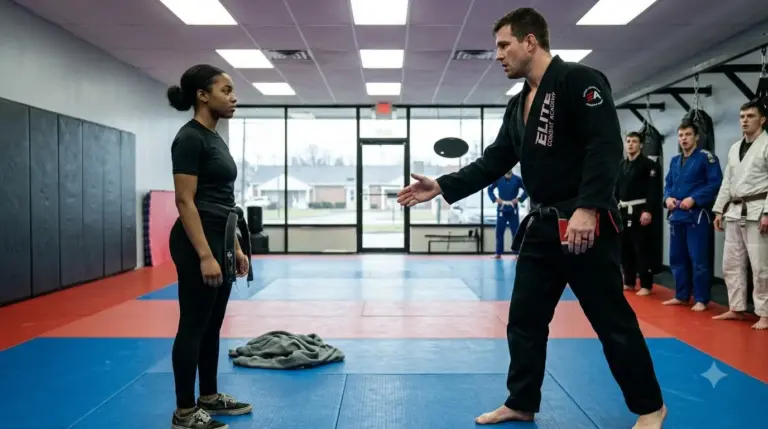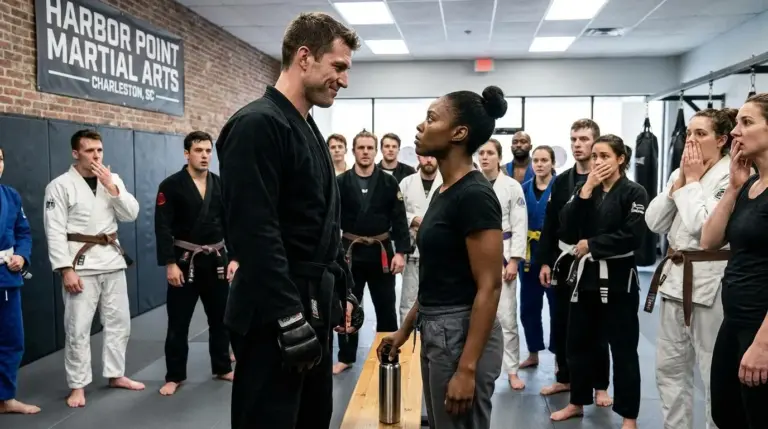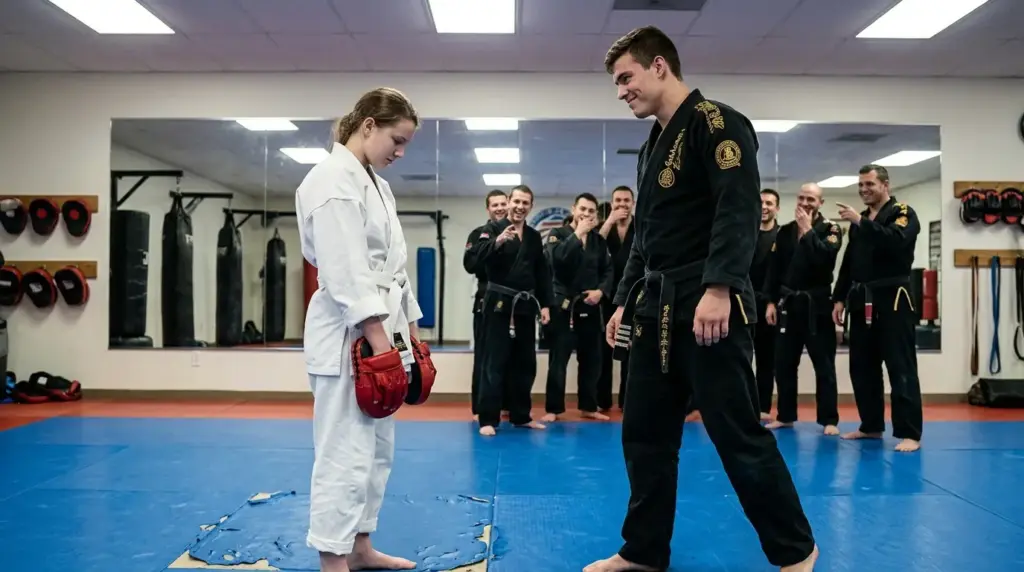
“You’re trying to embarrass me.”
Several students looked at Trent.
His face reddened.
“That what you think?”
“Yes.”
Trent laughed.
“Then put gloves on.”
Graham stepped between them.
“No.”
Trent looked toward him.
“She’s acting tough.”
“She’s fourteen.”
Graham said.
That sentence finally brought the situation into focus.
Not a rank problem.
Not an ego contest.
An adult-class student provoking a minor.
Graham’s expression changed.
“We’re done.”
Trent started arguing.
“She challenged—”
“No.”
Graham cut him off.
“She didn’t.”
“She said she was done.”
“You kept pushing.”
Trent stared.
“But she just—”
“Go get water.”
That should have ended it.
But the damage had already exposed something.
Graham looked toward Holland.
“How much training do you actually have?”
Holland’s stomach dropped.
There it was.
The question she had avoided.
“Some.”
Trent laughed from several feet away.
Graham ignored him.
“What style?”
“Kyokushin.”
“How long?”
“Eight years.”
The room changed.
Graham stared.
“Eight?”
“Yes.”
“Rank?”
Holland looked toward the white belt tied badly around her waist.
“My black belt is in a box.”
Nobody laughed now.
Trent frowned.
“Bullshit.”
Graham turned sharply.
“Enough.”
Then back to Holland.
“School?”
“Seishin Karate in Raleigh.”
“Sensei?”
“Masaru Ito.”
Graham knew the name.
Not personally.
By reputation.
Regional Kyokushin community.
Old-school.
Serious.
“Competition?”
Holland looked uncomfortable.
“Yes.”
“How much?”
“Some.”
Trent gave another laugh.
Holland finally looked at him.
“Three national youth championships.”
Silence.
Miller, who had returned from his phone call, stared.
Graham blinked.
“Three?”
Holland nodded.
“Yes.”
Nobody said anything for several seconds.
Then Graham did something correct.
He did not ask Holland to prove it.
He did not say:
Show us.
He did not turn the room into another performance.
He asked:
“Why didn’t the front desk put this on your form?”
“They asked current belt.”
“My belt isn’t here.”
“You said white?”
“I said I needed a loaner.”
Graham rubbed his forehead.
Of course.
Holland had been given the loaner belt automatically.
The front-desk employee had assumed.
Then Graham had assumed.
Then Trent had assumed.
One mistake stacking on another.
Trent crossed his arms.
“National doesn’t mean anything depending on organization.”
Holland looked toward him.
“You’re right.”
That answer surprised him.
She continued:
“Different rules.”
“Different divisions.”
“Different quality.”
“Doesn’t mean I’m better than you.”
Trent stared.
Holland added:
“It means I wasn’t a beginner when you decided I was.”
Graham looked at Trent.
The distinction mattered.
Trent was nineteen.
Larger.
Adult-sized.
Experienced.
Holland’s tournament accomplishments did not mean she could safely fight him under unrestricted rules.
Her skill did not transform biology.
And it certainly did not make a real fight between them a good idea.
Graham said:
“There will be no sparring between you two.”
Holland nodded immediately.
“Good.”
Trent rolled his eyes.
Graham saw.
“Something funny?”
“No.”
“Then class is over for you.”
Trent’s head snapped around.
“What?”
“You’re done tonight.”
“Because she has some medals?”
“No.”
Graham said.
“Because I told you to back off and you still can’t stop.”
That was the first real consequence.
Trent untied his gloves angrily.
Miller looked away.
The other black belts suddenly became fascinated with the floor.
Holland removed the oversized gi top.
She wore a faded gray T-shirt beneath it.
Then untied the white belt.
Graham watched.
“I’m sorry.”
Holland looked up.
“For what?”
The question caught him.
Graham considered.
“For not checking the class roster.”
“That wasn’t your fault.”
“For dismissing you before I knew anything.”
“That’s different.”
He nodded.
“And for seeing Trent lose control during the pad drill and not stopping it immediately.”
Holland touched her ear.
“Yeah.”
Graham accepted it.
No explanation.
No:
I was busy.
No:
I thought he had it handled.
Just yes.
Then he said:
“You should have been able to say you were done without telling us your résumé.”
Holland looked at him.
That was the first thing anybody had said all evening that made her feel better.
“Thank you.”
She gathered her clothes.
Graham said:
“You don’t have to come back.”
Holland almost laughed.
“That’s a strange sales pitch.”
He smiled weakly.
“I mean, I’d understand.”
“I know.”
“You’re welcome here if you want to be.”
She looked around.
The peeling mats.
The mirrors.
Trent stuffing gear angrily into his bag.
Students avoiding her eyes because thirty minutes earlier several had laughed.
Holland said:
“I don’t know.”
“Fair.”
Outside, the evening air felt colder than she expected.
Her mother’s silver sedan idled near the curb.
Lisa Wright sat behind the wheel wearing oversized sunglasses even though the sun was almost gone.
A cigarette glowed between her fingers.
Holland opened the passenger door.
Lisa looked over.
“You’re early.”
“Yeah.”
“Did you hit something?”
Holland leaned her head against the window.
“Not really.”
Her mother looked at the red mark on Holland’s ear.
“What happened?”
Holland hesitated.
Then told her.
Not the dramatic version.
The actual one.
Wrong class.
Mocking.
Pad drill.
Hard shot.
Argument.
Graham stopping it late.
Her background coming out.
Lisa crushed the cigarette into the ashtray.
“I’m going back inside.”
Holland grabbed her wrist.
“No.”
“Holland.”
“No.”
“He hit you.”
“During a drill.”
“Too hard.”
“Yes.”
“And the instructor let him?”
“Sort of.”
Lisa reached for the door.
Holland held tighter.
“Mom.”
Lisa stopped.
Her face looked exhausted.
The anger drained enough for something else to appear.
Fear.
“You’re okay?”
“Yes.”
“Are you sure?”
“Yes.”
“Headache?”
“No.”
“Dizzy?”
“No.”
“Nauseous?”
“I was nauseous before class.”
Lisa stared.
Then laughed despite herself.
“Not helping.”
Holland smiled faintly.
“I’m okay.”
Lisa started the car properly.
“Do you want to file something?”
“I don’t know.”
“Do you want to go back?”
“I definitely don’t know.”
Lisa nodded.
For once, she did not tell her daughter what to feel.
They drove away.
At home, Holland photographed her ear.
Not because she expected a lawsuit.
Because Sensei Ito had spent years telling students:
“If something happens, remember accurately before you remember emotionally.”
She emailed the picture to herself.
Then wrote down the sequence while it was fresh.