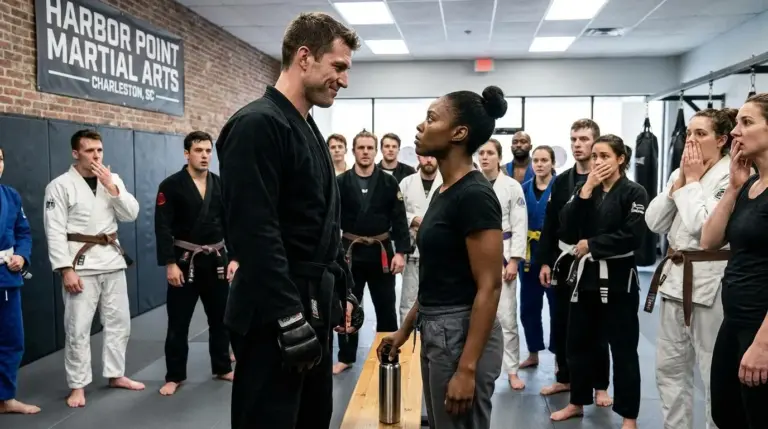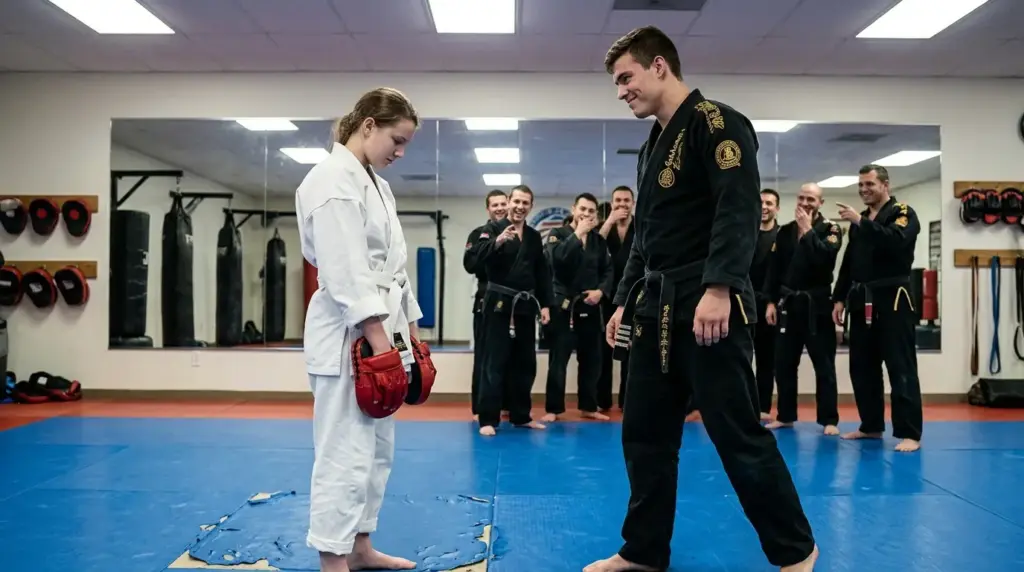
The next morning, Graham Foster did the same thing from his side.
He reviewed security footage.
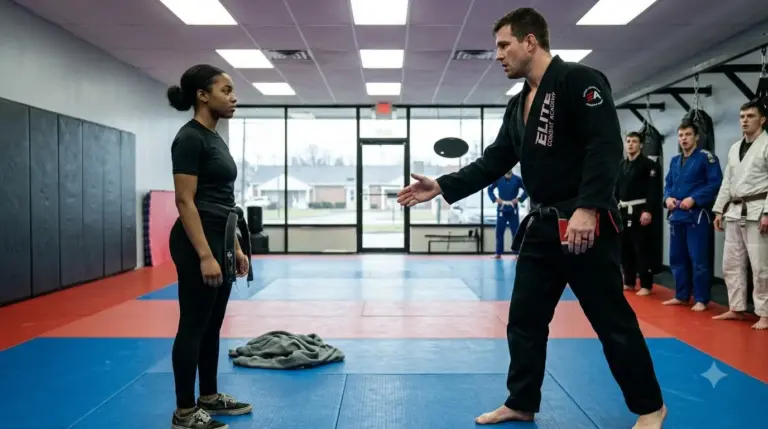
The video showed the entire pad drill.
Trent increasing power.
Holland repeatedly stabilizing the targets.
The off-target punch.
Her dropping the mitts.
Her saying:
“I’m done holding.”
Then Trent pushing.
The recording created no heroic image.
No teenager knocking out a larger adult.
What it showed was worse for the dojo.
An experienced nineteen-year-old black belt repeatedly using unnecessary intensity with a fourteen-year-old visitor while an instructor failed to intervene quickly enough.
Graham watched it twice.
Then called Coastal Athletics’ owner, Michelle Foster.
His older sister.
Michelle watched the video.
Her first question was:
“Why was she in that class?”
“Front-desk error.”
“Why did you leave her there?”
“I thought stretching was harmless.”
“Why was she holding pads?”
“We had an odd number.”
Michelle stared.
Graham closed his eyes.
When explained sequentially, every individual choice sounded small.
Together, they sounded irresponsible.
Michelle asked:
“Did she consent?”
“To hold?”
“Yes.”
“Did she understand Trent?”
Graham looked at her.
“What does that mean?”
“Did she know he has a history of escalating drills when he feels challenged?”
Silence.
Graham looked down.
That was the question.
Trent had not seriously injured anyone before.
But he had warnings.
Too hard in sparring.
Talking down to lower ranks.
Turning technical drills into competitions.
Using rank as social authority.
Nothing individually severe enough that management had felt forced to act.
So they had not.